
Surry County Parole and Probation Types
Probation, parole, and post-release supervision answer different questions. Probation follows a court judgment and can allow a person to remain in the community subject to conditions. Parole is conditional release available mainly under older or specially applicable sentencing law and depends on the North Carolina Post-Release Supervision and Parole Commission. Post-release supervision, often shortened to PRS, is the supervised community portion of covered modern felony sentences after prison confinement ends.
The distinction matters when reading a Surry County release record. A probationer may never have served a state-prison term. A parolee has left prison under Commission authority before sentence expiration. A person on PRS has moved from confinement into the statutory supervised phase, but the sentence has not necessarily ended. None of those labels means the person is currently held at the Surry County Detention Center.
| Supervision type | How it begins | Primary authority | What release means |
|---|---|---|---|
| Probation | Court judgment | Court and NCDAC Community Supervision | May follow a suspended sentence rather than prison release |
| Parole | Conditional release under eligible law | Post-Release Supervision and Parole Commission | Prison ends, but conditions continue |
| Post-release supervision | Statutory transition after covered prison term | Commission and NCDAC Community Supervision | Confinement ends while sentence supervision remains active |
Verify Surry County Post-Release Supervision
Begin with the official NCDAC Offender Public Information search. Use the offender number when it is known, since a name can match more than one person. Select a broad enough scope to include inactive prison records, open each plausible result, and compare the offender number, birth information, conviction county, offense, sentence dates, and any displayed image before relying on the record.
- Confirm identity and record the NCDAC offender number.
- Read the incarceration status, Actual Release Date, and later admissions as one timeline.
- Read probation, parole, and PRS entries separately from prison status.
- Note the supervision type, effective dates, and office information exactly as displayed.
- Use the live NCDAC office directory to identify the responsible public office.
- Ask that office whether the displayed public status and office assignment are current.
A Surry conviction does not guarantee supervision from an office in Surry County. Residence, an approved transfer, interstate placement, and specialized assignments can change office responsibility. When calling, provide the full name, offender number, and the exact public entry in question. Ask for status and routing, not private home information, case notes, treatment details, risk material, or officer-safety information.
Note: An inactive prison entry can coexist with active supervision, so both parts of the NCDAC timeline must be read.
Surry County Release Supervision Contacts
NCDAC Community Supervision manages field supervision, while the Commission handles parole and PRS decisions within its authority. The official Community Supervision overview explains the field agency, and its judicial-divisions and local-offices directory supplies the current office roster. Using the live directory avoids relying on an old Surry County office assignment that may no longer apply.
NCDAC Community Supervision
Use the official office directory for the current division and field-office contact.
Best for reporting-office, active-status, and office-routing questions.
Post-Release Supervision and Parole Commission
2020 Yonkers Road
4222 Mail Service Center
Raleigh, NC 27699-4222
919-716-3010
Fax: 919-716-3987
Parole.Commission@dac.nc.gov
Contact the Commission about its process, a discretionary parole review, or public decision information. Routine reporting and field-office matters belong with Community Supervision. A probation judgment also remains a court record, so the Surry court file can establish the legal terms even when NCDAC supplies the current supervision entry.
Surry County Parole Review Results
North Carolina ordinary parole review is an administrative file-review process, not a courtroom-style public hearing with a daily docket. The Commission describes commissioners reviewing eligible cases and voting individually. No official future hearing calendar for ordinary cases was found. A search for an upcoming public date should therefore shift to the person’s OPI record, Commission notices when available, and direct Commission contact.
The official Discretionary Parole Reviews channel publishes monthly case-review and decision files beginning with September 2024. Those files are retrospective results, not scheduled hearings. They may identify an offender number, review category, and published action, while the rationale and deliberative case material can remain confidential.
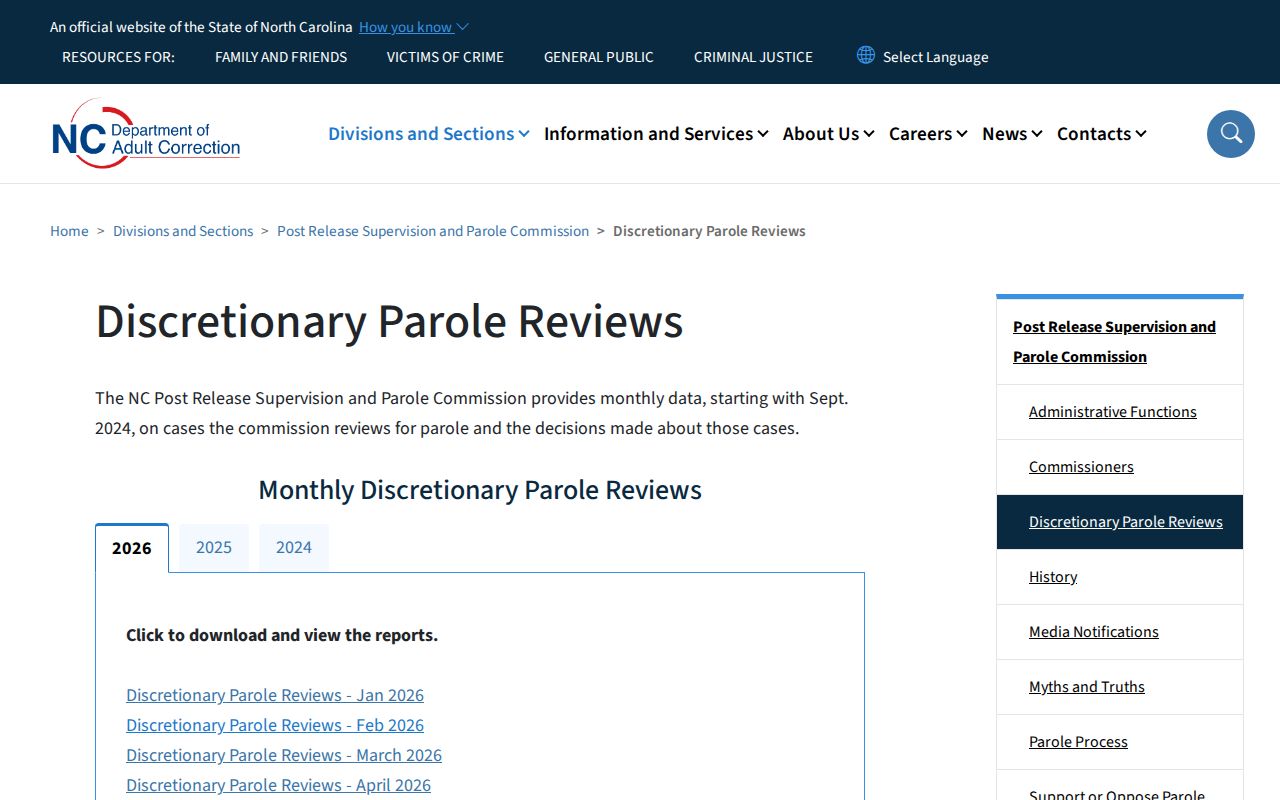
After finding a monthly entry, return to OPI to check present status and any Actual Release Date. A favorable action may still precede investigation, an approved plan, conditions, and physical processing. A denial records the result of that review; it does not support speculation about confidential reasons.
Surry County Parole Eligibility Records
Parole eligibility turns on offense date, sentence type, and the controlling law. North Carolina Structured Sentencing generally removed ordinary discretionary parole for offenses committed on or after October 1, 1994. Modern felony cases usually move toward PRS instead. Older-law cases and narrow special categories must be checked individually rather than assigned a release fraction.
G.S. 15A-1371 contains the detailed eligibility and decision provisions for covered sentences. Eligibility creates an opportunity for review, not a promise of approval or a fixed release date. A sentence imposed later can still concern an older offense, so the offense date, judgment, OPI sentence block, and Commission record must be compared.
The published results use North Carolina terms such as Incomplete Decision, Suspend Decision, Regular Parole, Community Service Parole, Early Medical Release, 90-day Mandatory Parole, and Denial. Preserve the exact category instead of substituting labels from another state. A procedural result may mean more information or investigation is needed rather than a final refusal.
Note: A Commission decision and an institution’s Actual Release Date are separate records that may occur at different points.
Surry County Absconder and Warrant Checks
Supervision conditions come from the controlling judgment, Commission action, and official case record. A suspected violation can lead to investigation, modification, a court or Commission proceeding, revocation, or a return to custody, but the result must be confirmed in the record rather than predicted from a public status label.
An absconder label means the supervising authority has identified an alleged failure to remain available or comply with required supervision contact. It is not a new conviction, and it should not be applied merely because someone missed an appointment or cannot be found through a broad name search. The official NCDAC absconder channel is the appropriate public starting point.
If OPI or the official channel shows an absconder status, quote the exact wording and record the access date. Then ask NCDAC whether that public status remains current. A warrant is a separate legal record. Confirm its existence, issuing authority, service status, and scope with the responsible court or law-enforcement agency instead of inferring those facts from the supervision label.
No reliable populated Surry-specific supervision-absconder or most-wanted list was established through the official channels. An empty, unavailable, or delayed list does not prove compliance, discharge, or absence of a warrant. Use OPI, Community Supervision, and the official Surry Sheriff detention channel for custody-specific confirmation.
Surry County Release Account Questions
Money held during a Surry County Detention Center stay belongs to a different record path than parole or probation. The Sheriff’s official inmate-accounts page is the local starting point for questions about funds held in custody and the balance at release. A roster entry, court judgment, OPI record, or Commission result should not be expected to state how a jail account was handled.
Ask the detention facility about the actual account disposition tied to the specific booking. Keep that question separate from court fines, restitution, supervision obligations, and fees for copies of public records. No universal Surry release fee or pay-to-stay amount was established, so no standard charge should be inferred from an account question.
This local separation prevents a practical release issue from being mistaken for a supervision condition. The Surry County released-inmate search and records guide explains how the jail movement entry and court disposition establish the custody event, while the account channel addresses funds only.
Surry County Supervision Release and Discharge
Release from prison and discharge from a sentence are not interchangeable. Under G.S. 15A-1368.2, release to PRS begins a supervised phase. OPI can therefore show an Actual Release Date and an active PRS status at the same time. Successful completion or another lawful Commission action may later terminate supervision and the sentence.
Parole is also conditional. Modification, violation proceedings, revocation, and return to custody can follow an earlier release. A historical parole or prison-release date remains part of the record even after a later admission, so check the full OPI chronology rather than stopping at the first favorable date. Consecutive judgments or another agency’s hold can also continue control after one sentence ends.
When the exact endpoint matters, request the Commission or NCDAC record that identifies supervision completion or sentence termination. For probation, obtain the court judgment and later termination, modification, or revocation orders as applicable. Do not calculate a discharge date by adding months to an old release date because tolling, violations, and lawful changes can alter the result.
Surry County Release Status Boundaries
A Surry County jail release, an NCDAC prison release, and an end to supervision are separate events. Current Confinements is a present jail roster, so a missing name does not explain whether the person returned to the community, entered state prison, moved to another jail, or entered another agency’s custody. The Sheriff movement record identifies the county event; OPI identifies state corrections history.
NC SAVAN, also called VINELink, can add an agency-fed custody event and notification, but it does not replace the source record. A transfer event is not community release. The NCSBI registry is narrower still and applies only when registration law covers the person; presence or absence there does not establish general parole, probation, or custody status.
For a reliable chronology, match the offender number, identify the custodian that recorded each release, check active supervision, and obtain the court or agency termination record when discharge is the question. That sequence preserves the difference among a legal decision, physical departure, community supervision, and final termination.
Note: Release from one agency does not rule out a transfer, detainer, later admission, or active supervision under another record.