
North Carolina Prison Release Records
The North Carolina Department of Adult Correction operates the state prison and community-corrections record system. A person transported from the Surry County Detention Center after a felony judgment has entered or continued state custody, not gained release merely because the county roster no longer shows the name. NCDAC Offender Public Information, commonly called OPI, becomes the correct public search route for that state episode.
No state prison was established as physically located in Surry County during the research sweep. This page therefore describes the statewide North Carolina system serving a person whose conviction or prior jail episode connects to Surry. A later OPI Actual Release Date can document departure from state confinement, and a supervision entry may show that correctional control continued in the community.
Search North Carolina Prison Release Records
Start at the NCDAC search gateway because it explains the system boundary and links the general OPI and related tools. Use an offender number when available. A unique state identifier is safer than a name, especially when several people share similar spellings.
The NCDAC Criminal Offender Searches gateway is the official entry point.

- Obtain the NCDAC offender number from an official record whenever possible.
- Open general OPI and choose a scope broad enough to include inactive records, since a current-only filter can exclude a released person.
- Search by offender number, or begin with surname and given name when no number is known.
- Compare birth information, conviction county, offense, sentence dates, photograph where displayed, and offender number across plausible matches.
- Read incarceration and community-supervision statuses separately, then review each admission, movement, sentence, and release block in time order.
- Record the exact labels and access date, and request the underlying record when a dynamic result is not enough.
North Carolina Prison Release Search Fields
OPI results must be treated as timelines rather than one status badge. A historical release can coexist with a later admission, and inactive prison status can coexist with active supervision. The fields below answer distinct questions.
| Field | Release-record meaning |
|---|---|
| Offender number | Identifies the state corrections record and reduces same-name errors. |
| Incarceration status | Shows whether the displayed prison episode is active or inactive, subject to its exact wording. |
| Projected Release Date | Provides a prospective calculation based on sentence data then in effect; it can change. |
| Actual Release Date | Documents that NCDAC recorded a release event for the listed incarceration episode. |
| Type of Release | Adds the state category and should be quoted rather than translated into sentence completion. |
| Admission and movement entries | Show the sequence of state custody and transfers between institutions or programs. |
| Sentence and offense data | Connect the release event to the relevant judgment, terms, and conviction record. |
| Supervision status | Can show parole, probation, or post-release supervision after confinement ends. |
A photograph assists with identity but does not establish guilt or current custody. When one field conflicts with another record, confirm that both concern the same sentence and incarceration episode before asking NCDAC to explain its labels.
North Carolina OPI Release Details
The general OPI form is person-centered. It works best when the reader knows an offender number or enough reliable identifying information to isolate one record. Add demographic refiners only when they are trustworthy because OPI applies selected criteria together and one wrong detail can suppress the correct result.
The official OPI search form provides the statewide name and offender-number route.
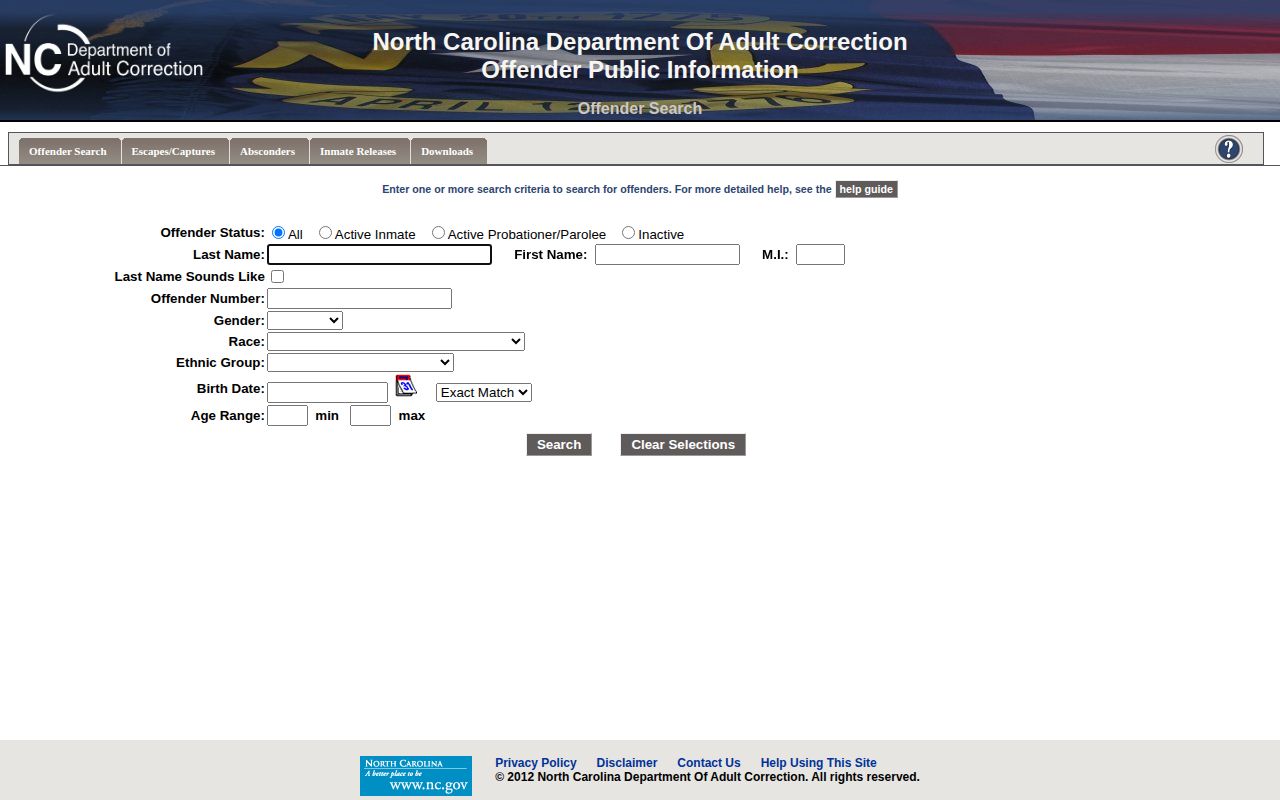
Open each plausible match and review later entries, not only the first release found. An old Actual Release Date proves the end of that listed episode. It does not establish that the person remained out of all custody afterward. Later admissions, revocations, movements, or sentences may change the present description.
North Carolina Dedicated Release Search
The separate NCDAC offender release search is event-centered. It is useful when a release month, year, surname, or county association is known but the offender number is not. Select the date controls available on the live form, enter a surname, and use broader spelling options only when necessary. Review the result's offender number, name, Release Date, primary offense or qualifier, and Type of Release before opening the linked individual record.
The official NCDAC release-search form is the direct event route.
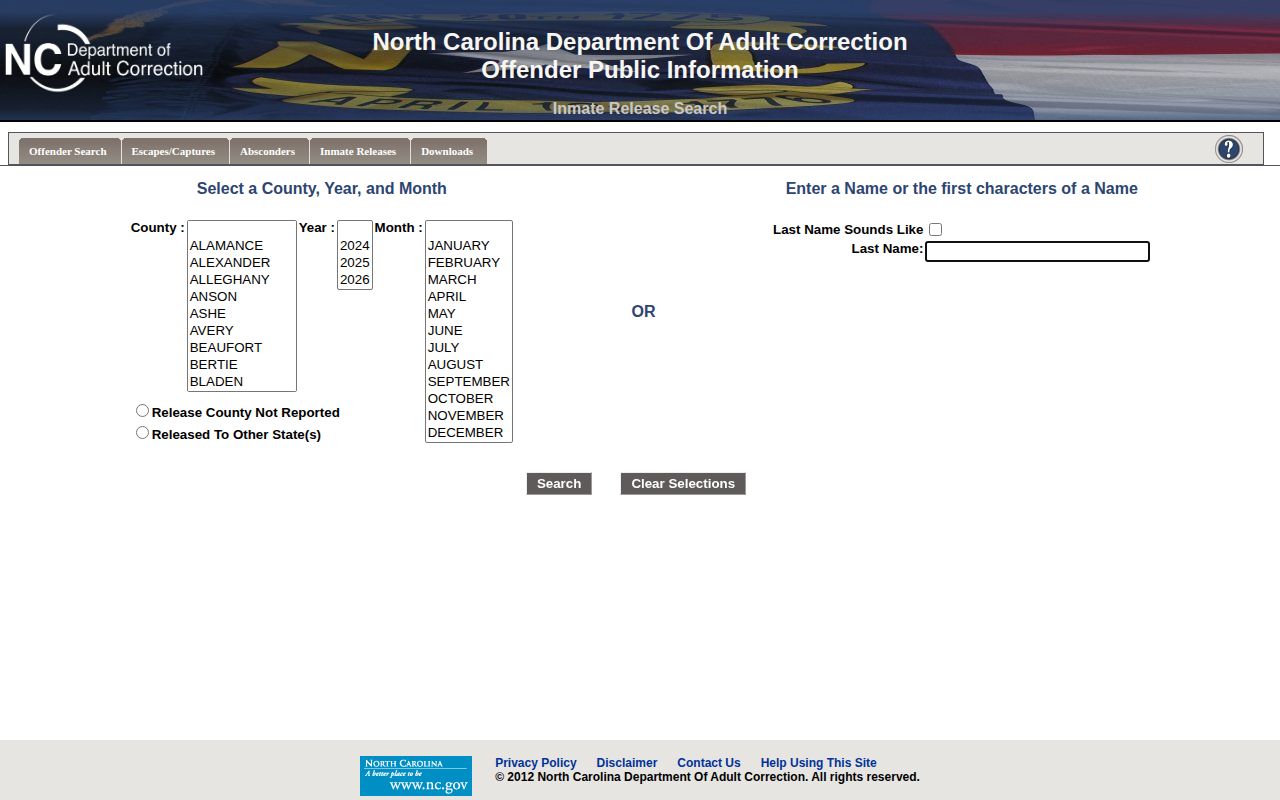
A Surry county filter or association does not prove the person departed a prison located in Surry or left the Surry County Detention Center. It remains an NCDAC release record whose county field follows state data definitions. Use the individual record and agency confirmation before making a more specific location claim.
Note: A county association in NCDAC data does not identify a prison building or county-jail departure site.
North Carolina Projected and Actual Release
Projected Release Date is a calculated future endpoint based on the sentence and corrections information then in effect. It can change after sentence calculations, disciplinary action, court modification, detainers, sentence corrections, or other lawful adjustments. Actual Release Date is historical evidence that NCDAC recorded the end of the specified confinement episode. These labels must not be merged.
North Carolina structured sentencing also cannot be reduced to a universal percentage rule. The felony framework distinguishes minimum and maximum terms, and earned time cannot reduce the maximum below the minimum for covered sentences. Time already served and prison earned time are different concepts. Sentence regime, offense date, judgment, and official corrections calculation control the result for an individual record.
For a county sentence served only at the Surry County Detention Center, OPI is not a release calculator. Use the judgment, documented time already served, and the Sheriff's actual movement entry. The Surry County Detention Center record path covers that separate local custody evidence.
North Carolina Post-Prison Release Status
Release from prison can begin post-release supervision or parole rather than end the correctional sentence. Probation is ordinarily a court-imposed community sentence or component and is not simply another word for parole. Modern structured-sentencing cases generally use post-release supervision, while parole remains relevant to older-law and specially eligible sentences.
Read the OPI incarceration status, Actual Release Date, and supervision status as separate stages. An inactive prison episode with active supervision means the person can be outside prison while still under NCDAC control. A supervision violation or revocation can later lead to another custody event, so the newest compatible entries should control any statement about current status.
Release does not equal discharge. Prison departure ends confinement for the identified episode, while discharge reflects completion or lawful termination of the correctional sentence. If the question concerns the final endpoint, obtain the NCDAC or Commission record that identifies supervision completion or sentence termination. Do not derive it by adding a fixed period to the prison release date because violations, tolling, and lawful modifications can change the chronology.
Note: Prison departure, community supervision, sentence discharge, and a later revocation are separate events that can carry different official dates.
Request North Carolina Prison Release Records
When OPI is incomplete or identity remains uncertain, use NCDAC's public-records route. Identify the offender number and the exact admission, sentence, movement, or release episode. Ask for existing public records rather than a new calculation or legal opinion. State the fields needed, such as actual release date, type of release, relevant movement, and public supervision status.
The official NCDAC Public Records page explains the state request channel.
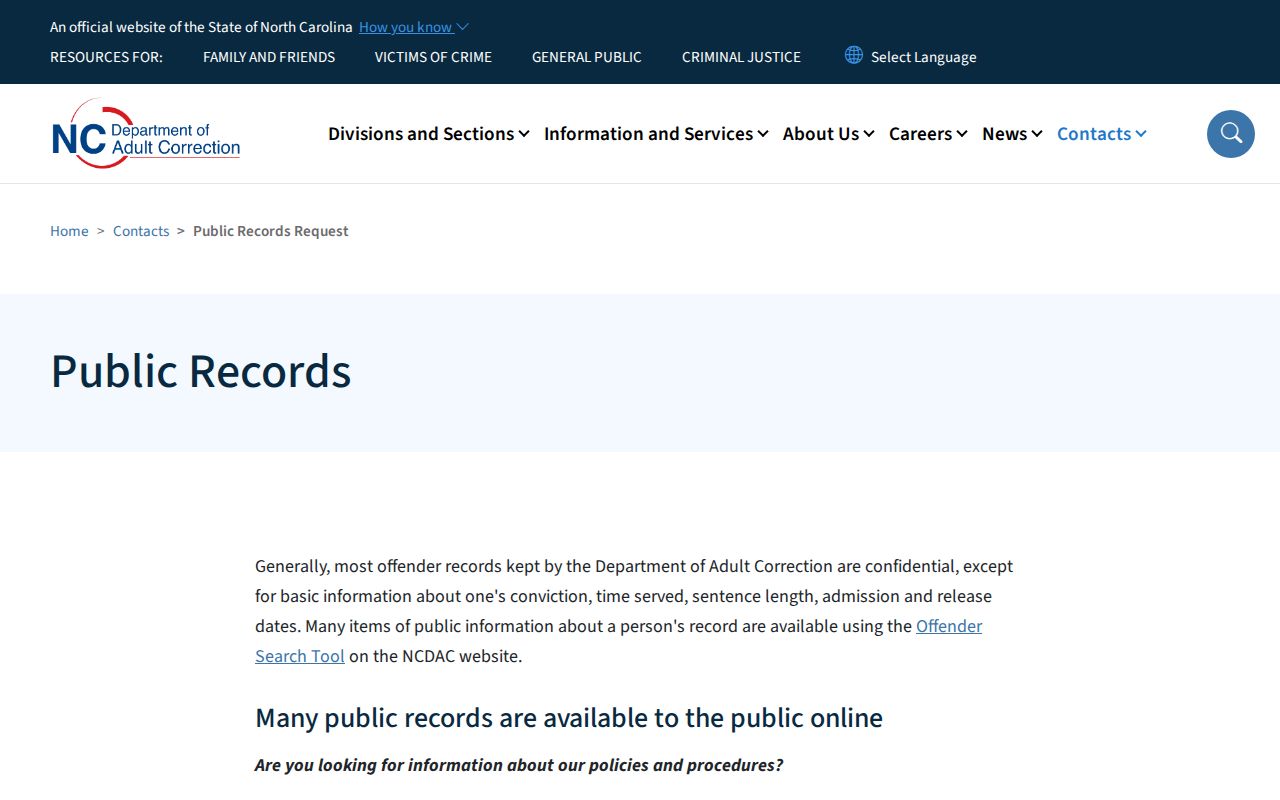
Corrections confidentiality rules can protect medical, psychological, security, victim, intelligence, classification, and other case material. Public OPI fields do not make every underlying document open. If information is withheld, ask for the governing basis and any separable public portion. For Surry jail records, direct the request to the Sheriff because NCDAC does not maintain the county booking ledger.
Note: Identify the offender number and exact incarceration episode so NCDAC can distinguish the requested release record.
North Carolina Prison Records Contact
The correct contact is the statewide North Carolina Department of Adult Correction rather than a prison claimed to be physically located in Surry County. Use the offender-search gateway for public records already online and the NCDAC records page for a focused request. The research supports no Surry-based state-prison address or local prison contact card.
North Carolina Department of Adult Correction
System: North Carolina state prison and community-corrections records
Search: Criminal Offender Searches gateway
Records: NCDAC Public Records
Use the Surry County released-inmate search path when the central question is whether a county booking ended in community release, state transport, federal movement, or another receiving authority.