
Surry County Projected and Actual Release Dates
A Projected Release Date is a corrections calculation based on the sentence information, credits, and rules recorded at that time. It is prospective and can change. An Actual Release Date is historical evidence that NCDAC recorded the end of a particular state-custody episode. The Actual Release Date is stronger proof of that event, but later admissions or another custodian can still appear elsewhere in the chronology.
A scheduled date is also narrower than full sentence completion. A state prisoner can leave confinement and begin parole or post-release supervision. OPI may correctly display an Actual Release Date while also showing active community supervision. The release type and supervision entry must be read with the date instead of translating prison departure into an unconditional discharge.
Pretrial detention has no sentence-derived projection. Bond, dismissal, a release order, case outcome, a detainer, or a transfer may control departure from the Surry County Detention Center. The county’s current-confinement portal cannot calculate those legal and operational events.
Surry County State Release Date Portals
The NCDAC Criminal Offender Searches gateway is the safest state starting point because it explains the boundary of the available tools. The general Offender Public Information search is person-centered. It can show status, sentence history, supervision, Projected Release Date, and Actual Release Date for a state corrections record.
The separate NCDAC Inmate Release Search is event-centered. Its live fields can help when a release month, year, surname, or release county is known. Results may supply offender number, name, Release Date, Primary Offense or qualifier, and Type of Release, followed by a link to the individual history.
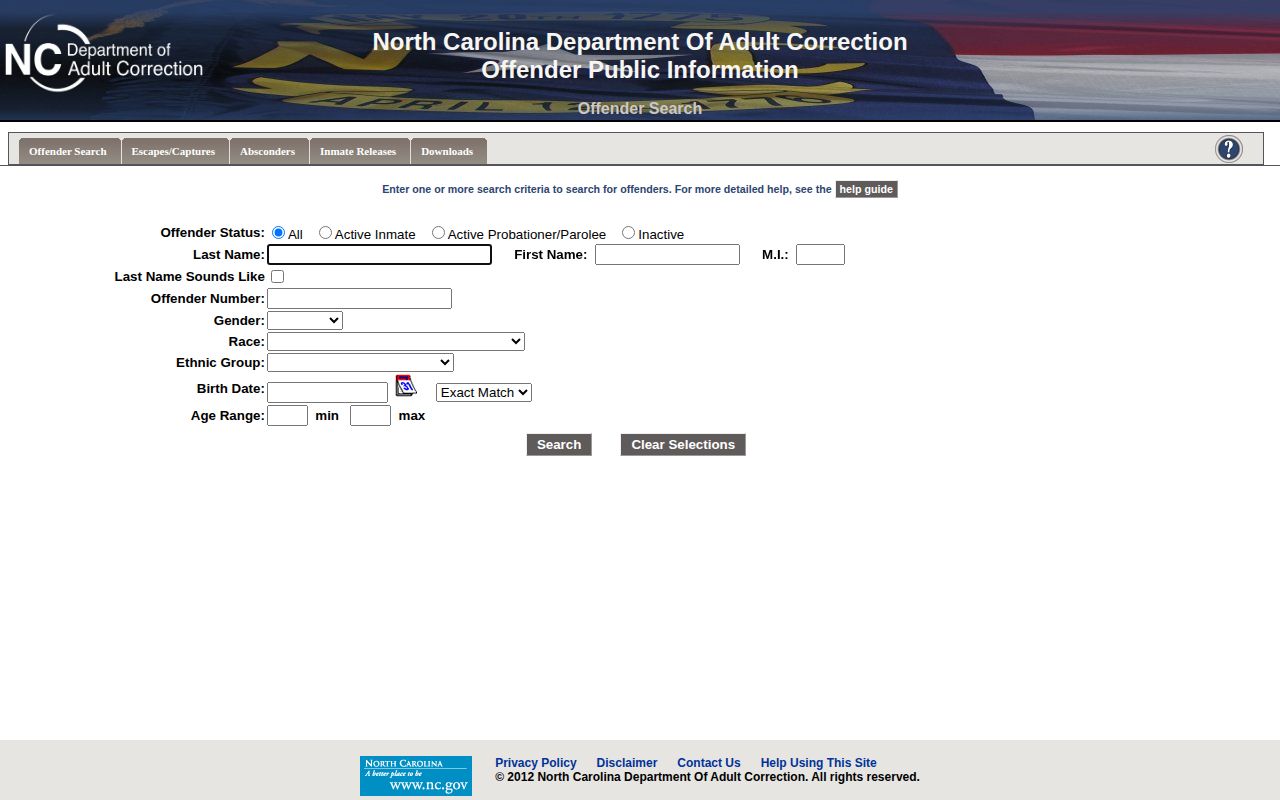
A county choice in the state release search must be read under NCDAC’s field definitions. A result associated with Surry does not prove that the person physically left the Surry jail or a prison located in Surry County. It is a state-corrections release entry associated with Surry unless the individual record and agency confirmation establish a more specific place.
Find a Surry County Inmate Release Date
Classify the last known custody before searching. A county booking number belongs with the Surry Sheriff record. An NCDAC offender number belongs in the state correctional tools. A person held only before trial, sentenced only to county time, or released on bond may never have a state prison episode. Conversely, disappearance from the county roster may reflect transport into NCDAC rather than release.
- Obtain the offender number or county booking number from an official record.
- For state custody, search broad enough to include inactive OPI records and open every plausible match.
- Compare birth information, conviction county, offense, sentence number, and offender number.
- Read each sentence block for Projected Release Date, Actual Release Date, movements, and release type.
- Check later admissions and active probation, parole, or PRS entries.
- For county custody, obtain the judgment, credited-confinement information, and Sheriff release or movement entry.
- Near an estimated date, ask the current custodian to confirm the current calculation.
Record the exact field wording, offender number, and access date. If an OPI date conflicts with a judgment or jail statement, do not choose whichever is earlier. Ask which sentence episode, legal authority, or physical event each date represents. The Surry County released-inmate records path gives the broader sequence for matching the jail, court, and receiving-agency records.
Note: A released person may appear in an inactive state record, while a current jail roster is designed to show present confinement.
Surry County Release Date Sentence Markers
North Carolina Structured Sentencing felony judgments use a minimum and maximum term. Under G.S. 15A-1340.13(d), earned time may reduce the maximum term but not below the minimum. G.S. 15A-1340.17 supplies the felony punishment grids and corresponding maximum-term structure.
That framework is why North Carolina should not be summarized with a universal “serve 85 percent” rule. Subtracting a percentage from either number can produce a date that matches neither the judgment nor NCDAC’s calculation. The governing regime also depends on offense date and sentence type. Older-law sentences, impaired-driving matters, life terms, special offenses, and other categories can follow different provisions.
The offense date, conviction date, offense class, sentence number, relationship among sentences, and credited confinement all matter. If multiple sentence blocks appear, identify the controlling or aggregated entry. Selecting the earliest date without reading concurrent and consecutive treatment can materially misstate the state-prison endpoint.
Surry County Release Credits and Earned Time
G.S. 148-13 authorizes NCDAC to establish regulations for earning, forfeiting, restoring, and applying time credits. Earned time can reflect qualifying conduct, work, programs, or other correctional rules. The statute does not provide one public daily formula that can be applied to every Surry County person.
Credit for prior confinement is different. Sentence-credit law, including G.S. 15A-1355, concerns legally creditable time already spent confined. Earned time and confinement credit can both affect a calculation, but one arises from correctional credit rules and the other from crediting earlier custody. Combining both under a loose “good time” label hides that distinction.
For misdemeanors, G.S. 15A-1340.20(d) includes the corresponding minimum-term limitation and an earned-time ceiling of four days per month within its framework. That ceiling is not an instruction to subtract four days for every month in every county case. The person must be serving a covered active sentence, and the custodian applies the governing rules to the actual record.
Note: Statutory authority for credits does not turn a public reader into the jail or NCDAC sentence calculator for one person.
Surry County Prison Release and Supervision
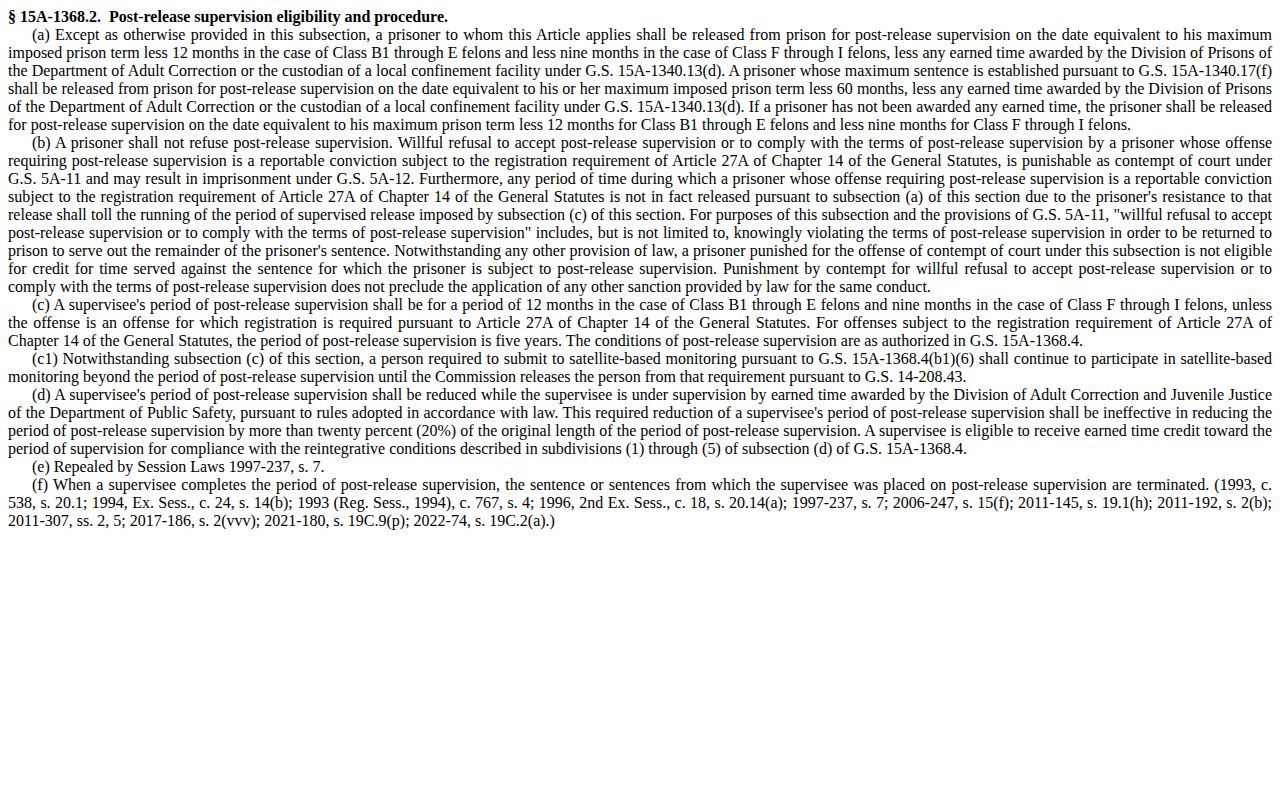
G.S. 15A-1368.2 governs release to post-release supervision for covered terms. In the ordinary categories stated by the statute, departure occurs at the maximum less a defined supervision period and applicable earned-time adjustments, subject to the statutory minimum floor. Some reportable convictions have a special maximum and supervision structure.
The supervision period is not simply erased from the sentence. The person leaves prison and serves that part under correctional supervision. Completion of PRS can terminate the sentence, while violation proceedings can change the later course. An OPI Actual Release Date and active PRS entry can therefore be fully consistent.
The official release-to-post-release-supervision framework shows the statutory boundary between prison departure and the supervised phase.
When reporting a projected date, identify the event it predicts: prison departure, release to PRS, eligible older-law parole, or sentence expiration. A prison-release projection should not be called the full sentence-completion date without a record that supports that legal endpoint.
Surry County Jail Release Date Evidence
Surry’s Southern Software portal does not publish a projected-release field or a sentenced-jail credit calculator. Its Current Confinements view and short-window admissions options do not calculate release. A person serving a county sentence must be researched through the judgment, the credited-confinement record, and the Sheriff’s actual release or movement entry.
The judgment provides legal sentence information. The Sheriff applies the governing record to the booking and documents the physical movement. The official Surry County detention channel is the local agency route, while the Surry County court portal leads to court records, calendars, forms, and local contact information. A court order may authorize release without documenting the exact time jail processing ended.
No official Surry rule establishing a standard release hour, weekend advancement, holiday adjustment, or local earned-time chart was found. Another county’s practice should not be imported. Ask the Sheriff how the judgment and credit were applied to the identified booking, and distinguish any administrative estimate from the completed movement record.
Why Surry County Release Dates Change
A defensible calculation follows a sequence. The court enters the judgment, minimum and maximum, sentence relationship, and confinement credit. NCDAC records the state sentence and applies controlling law and correctional rules. Later credits, forfeitures, judgments, and corrections can update the projection. PRS or parole law then determines whether prison departure begins a supervised phase.
| Change | Possible effect | Best record to check |
|---|---|---|
| Corrected confinement credit | Moves the calculation after missing or mistaken credit is posted | Judgment, commitment, and custodian calculation |
| Earned-time award, loss, or restoration | Changes the state corrections projection within the legal floor | NCDAC sentence and credit record |
| Consecutive or concurrent clarification | Changes which term controls or how terms combine | Court judgment and NCDAC sentence blocks |
| Resentencing, appeal, or vacated conviction | Changes the legal sentence entered into corrections data | Court orders and corrected commitment |
| Detainer or another authority | May prevent community return after one custodian releases | Movement record and receiving-agency record |
| Eligible parole action | Creates a decision point for an applicable older-law case | Commission result, then OPI Actual Release Date |
| Identity or data correction | Corrects a field without changing the underlying legal event | Agency correction and source record |
Not every update appears at once in the public interface, and one record may retain several sentence-block dates. An old screenshot is not a safe pickup plan. Recheck the offender number, sentence block, release type, and current custodian close to the projected date.
Confirm a Surry County Release Date
Near the projected date, ask NCDAC or the holding facility whether the displayed calculation remains current. NC SAVAN or VINELink can provide an agency-fed projected or actual release notification where supported, but an alert depends on the source agency’s entry and may arrive after physical processing. The Surry County VINELink release check explains how to match one person and verify the reporting agency.
After departure, use the Actual Release Date and exact release type for the relevant state episode. Check whether probation, parole, or PRS is active. For a county event, obtain the Sheriff’s release or movement record and compare it with the court order. If a transfer or detainer appears, use the receiving agency’s locator or record before describing community release.
A complete chronology keeps four stages distinct: the court’s legal sentence or release authority, the corrections projection, the physical release recorded by the custodian, and any later supervision or discharge. That method produces a Surry County inmate release date with a stated source and custody boundary instead of an unsupported promise.
Note: The newest compatible official records should control when an earlier projection conflicts with an Actual Release Date or later custody entry.